

Relief Starts With the Right Diagnosis
Two patients can both say “my eyes feel dry” and need different plans. Dr. Radzwill’s goal is to find your drivers—not only to label the symptom.
Symptoms and South Florida Triggers
Outdoor humidity does not cancel indoor dryness. These are the patterns we discuss most often with Fort Lauderdale patients.
Indoor environment
Office AC, bedroom vents, and fans reduce ambient moisture. Symptoms often worsen through the workday or after a night near a direct vent.
Sun, wind, and water
Beach days, boating, and patio time expose eyes to UV, glare, and wind—all of which can destabilize the tear film even when the air feels humid.
Screen and near work
Reduced blink rate during computer, phone, and reading sessions leaves the surface dry by afternoon. Blurred vision that improves with a blink is a classic clue.
Contacts and medications
Lens wear can amplify dryness when tears are already stressed. Some systemic medications and hormonal changes also affect tear quality over time.
How Dr. Radzwill Evaluates Dry Eye
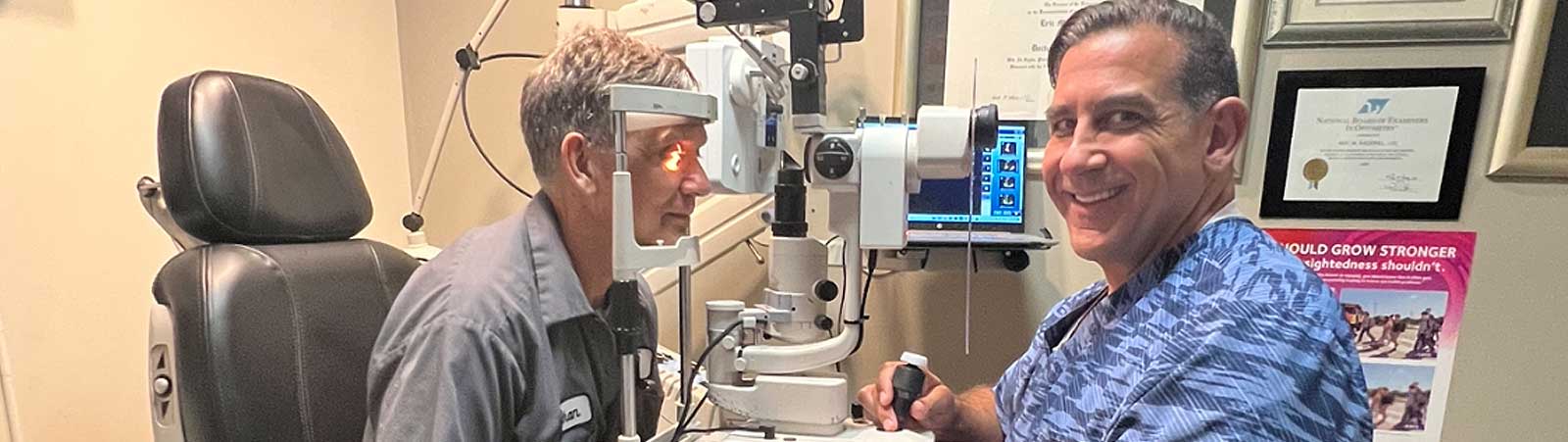
A useful dry eye visit is not “try these drops and hope.” Evaluation at Radzwill Optometric Associates typically includes a detailed history—your indoor environment, screen habits, contact lens use, medications, and when symptoms are worst—as well as slit-lamp assessment of the eyelids and ocular surface. Dr. Radzwill looks at tear quality, stability, and signs of meibomian gland dysfunction, which is a common cause of evaporative dry eye in our climate.
That level of detail matters because treatment should match the mechanism. Someone with oil-gland dysfunction will not get lasting relief from random artificial tears alone. Someone whose main issue is incomplete blinking at a dual-monitor desk may improve with habit changes plus targeted therapy. After more than twenty years serving East Fort Lauderdale, Dr. Radzwill recognizes these patterns quickly—including in patients who have already cycled through multiple over-the-counter products without a clear diagnosis.
Dry eye is often manageable, but it is rarely a one-visit cure. We explain what to expect in the first weeks versus longer-term maintenance, and we schedule follow-up when needed to adjust the plan. Patients who stay consistent—and return when something is not working—usually do better than those who chase a new bottle every time symptoms flare.
Treatment Options We Discuss
Plans are tailored to exam findings and your daily life—not a generic protocol.
Lubricating drops on a schedule
Preservative-free artificial tears used consistently—not only when eyes already hurt—often work better than reactive use.
Lid hygiene and warm compresses
Routines that support meibomian gland function can improve the oil layer and reduce evaporation, especially with AC-heavy lifestyles.
Prescription therapies when appropriate
Anti-inflammatory or tear-support medications may be recommended when the ocular surface needs more than over-the-counter care.
Environmental and lifestyle adjustments
Redirecting AC vents, humidifier habits, UV protection outdoors, and screen breaks are practical changes that support clinical treatment.
Contact lens modifications
Lens material, modality, or wear-schedule changes can restore comfort when dryness has made lenses intolerable by midday.
Nutritional and supportive factors
We discuss diet, hydration, and other factors that influence ocular surface health as part of a complete plan.
Dry Eye, Contacts, and LASIK
Unstable tears can make a glasses prescription feel “off” and can sabotage contact lens comfort. Before advancing specialty lenses or refractive surgery conversations, we want the ocular surface as healthy and predictable as possible. Many patients continue wearing contacts after the tear film improves and lens type or wear time is adjusted; others do better with glasses for part of the week. We decide together after evaluation—not from a one-size rule.
If you are exploring LASIK or other vision correction, a dry eye assessment belongs in that discussion. Dr. Radzwill provides laser vision consultations and co-management for appropriate candidates, and he addresses surface disease first when it would affect surgical outcomes or comfort. Learn more about broader medical eye services on our eye doctor Fort Lauderdale page.
Dry Eye FAQ
Is watery vision still dry eye?
Yes, it can be. An unstable tear film often triggers reflex tearing. Watery eyes alone do not rule out dryness.
Can AC really cause this in a humid climate?
Yes. Indoor air conditioning and fans are among the most common environmental factors we discuss with Fort Lauderdale patients.
Do I need special drops forever?
Some people need ongoing maintenance; others improve enough to simplify their routine after the surface stabilizes. Exam findings drive that answer.
Will dry eye keep me from wearing contacts?
Not always. Many patients return to comfortable lens wear after we improve the tear film and adjust lens parameters. Evaluation determines what is realistic for you.
Schedule a Dry Eye Evaluation
Radzwill Optometric Associates is inside LensCrafters at the Galleria Mall—convenient for patients in the 33304 area and across East Fort Lauderdale. Visit us at 2312 E Sunrise Blvd, Space B1, Fort Lauderdale, FL 33304, or call (954) 563-3450 to book. For neighborhood directions and parking, see our optometrist near me 33304 page. Bring a list of drops you have tried, your contact lens brand if applicable, and notes about when symptoms are worst.